Artificial Intelligence. It’s a bit of an oxymoron. We assume that our AI of choice is thinking, but really it is not thinking at all. It is scanning all available source material and assembling the information in a pleasing format that may or may not have accuracy behind it.
For example: You plug in your lab results and ask for an evaluation. It gives you one. It achieved this by scanning all avablale lab information and what the reference ranges are, what the implications of the results are, and also what the established treatments or. concerns are.
It says ‘thinking’ but it is not thinking. At least not yet. It is evaluating based on available material, much the same way you might do if you were researching a topic. And if the sources include social media, which it often does, you are not guaranteed to have accurate results.
Now the algorythms used have limits placed upon it. It will not tell you how to kill yourself, or someone else. Or, if you are a writer, like me, and want a novel way to kill a character, it will refuse on the grounds of that request violating its social guidelines. Probably just as well.
In the news there is a lot of AI bashing. Models trained by scouring the internet and the works of authors to teach this machine a certain writing style or format. And much like the social media memes of famous people doing things they never did, there is a lot of room for abuse.
That said, and despite the limited intelligence, AI remains a useful took. Like all tools, it can be used in a positive or negative way.
I will use AI to check punctuation, grammar and spelling, usually after a paid proofreader. No offense to the proofreader, but humans miss things and the AI is pretty darn good at catching them.
I will use AI for some elements of a book cover, not unlike buying stock imagery and using Photoshop to assemble a finished cover that works. My vision. My product.
And sometimes, when I am stuck on a plot point, I may banter with AI until a solution presents itself.
I believe, as a writer, that these are good uses for the technology.
The bad news is that everyone is now accusing everything of being AI. The use of em-dashes—a solid tool in writing and journalism—has been condemned as a clue of AI writing. It isn’t.
And running a story or novel through an AI detector will invariably offer a high AI percentage because it looks for patterns—perfectly normal patterns that do not, in itself, indicate AI. But once someone claims AI, everyone just accepts it as such.
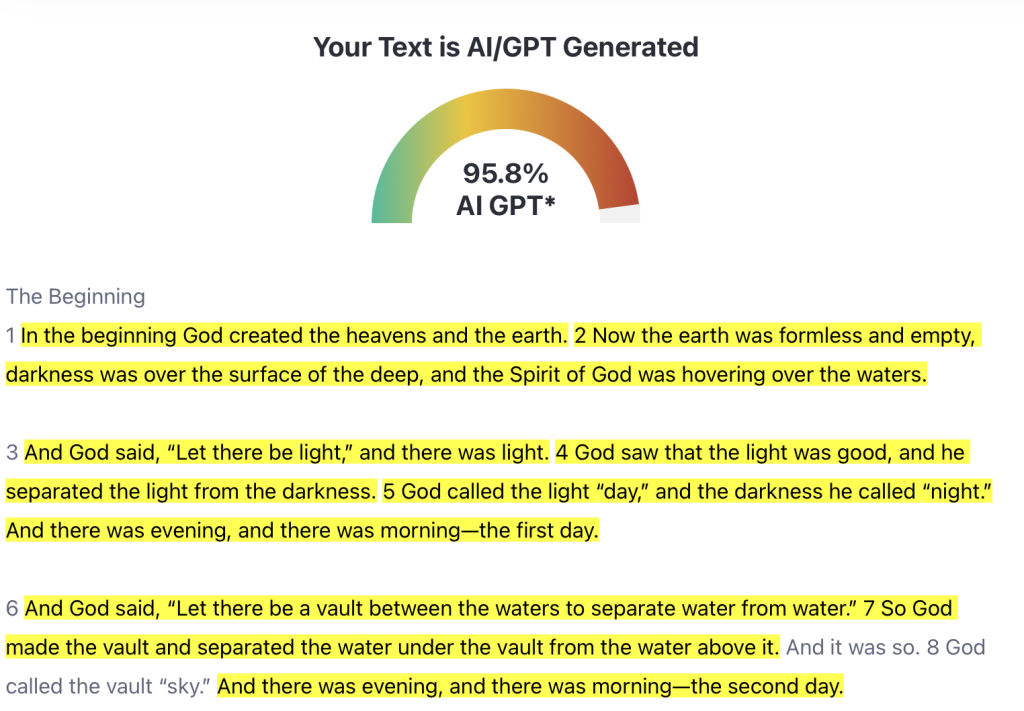
I ran Genesis through an AI detector——you know Genesis from The Bible. It came back 95.8% chance of being written by AI. I ran my own stories through the same detector and got a similar result.
So I decided to try an experiment. I created a story and asked AI to write it for me. I wanted to see how badly it would write. The result was a fairly decent story, except that there was a tell. AI added more words based on what I had written, to expand it, believing that it added depth. It didn’t.
It would write: ‘The tall man walked into the room as men always do when they enter a room. The room was small, small enough that tall men would not fit into the room itself, although the room would never think of it that way, as rooms are inclined to do.’
I ran that through the AI detector and it said 85% chance written by an AI. I asked that AI to rewrite th story so it would fool an AI detector. It wrote a revised version that I then passed through another AI to check and it reported 85% chance it was AI written. I repeated this three times each time asking the next AI to fix the story to be undetectable. It failed.
Finally, I revised the story, edited it out, condensed it, eliminated the fluff, added some new ingredients and polished it best I could. The AI reported 75% AI written. There’s no winning. If you just want to accept a flawed machine offering an incorrect evaluation.
The moral of the story is this: AI is a tool. Like paintbrushes in Photoshop that can be programmed to offer textures and styles, AI can be used in writing. It can improve badly constructed sentences, human created sentences, not unlike autotune does with singers or robots in surgery. But the bottom line is this. Is the story good? Does it read well? Did you steal the idea from elsewhere? Writing a story and having an editor suggest changes and edits, is the same thing. It is still the story written by a human. And if the story is very good and well written, and without the AI slop it likes to add, then I fail to see the objection.
Human or AI?
A test for you. Is this story passage AI or human?
She was pretty without trying, auburn hair falling around rosy cheeks and a smile that could stop a man mid-sentence. He was handsome in an easy, unassuming way, broad-shouldered and strong, aware of his looks but never inclined to show them off. There was a kindness about him, especially when he looked at her. And when she caught him looking, her smile changed, softened into something meant only for him. He would lean closer, she’d touch his arm, and for a moment they seemed to forget anyone else existed. People noticed. Some smiled, remembering what that felt like. Others looked away, wishing they had it.
Choose your answer below then click the link to find the answer. But be careful. It could be either. The passage is well written, not contrived at all. Perhaps it was a fantastic prompt that allowed the AI to develop a fleshed out story of this quality. Or perhaps I wrote it. You decide. Human or AI?
Don’t get me wrong. I am not advocating telling AI to write me a story and then fix it up and pass it off as human. But I believe the toolk can be used to make a story better, stronger, more vibrant, and heloiubg the author to achieve this, whether AI, mentor, editor, spell-checker, idea-generator, should be taken on the same level. AI slop for the sake of publishing something is entirely different.
And finally, the next two paragraphs are AI-improved versions of my previous two paragraphs.
The point is this: AI is a tool, not an author. Just as Photoshop provides brushes, textures, and effects that enhance an artist’s work, AI can help writers refine their craft. It can strengthen awkward sentences, improve clarity, sharpen dialogue, and polish prose—much as Auto-Tune assists singers or robotic technology enhances a surgeon’s precision. But ultimately, the questions that matter remain unchanged: Is the story compelling? Is it well written? Is it original? Does it engage the reader?
When a human author works with an editor who suggests revisions, restructures sentences, or recommends improvements, we don’t suddenly credit the editor with writing the book. The creative vision, characters, ideas, and storytelling remain the author’s own. If AI helps an author produce a stronger, more polished work without sacrificing originality or introducing the formulaic, soulless prose so often associated with AI-generated content, I fail to see why its use should automatically diminish the author’s achievement.
There is, however, an important distinction between using AI to improve writing and using AI to replace the writer. I am not advocating typing a prompt, having a machine generate an entire story, making a few cosmetic changes, and passing it off as a work of human creativity. That is fundamentally different from an author developing an original story and using available tools to make it better, sharper, and more engaging. Whether that assistance comes from a professional editor, a writing mentor, a grammar checker, a brainstorming partner, or AI, the principle is much the same: the tool supports the author’s creative process rather than substitutes for it.
What matters is who conceived the story, who shaped its characters and meaning, and who ultimately made the creative decisions. Publishing hastily generated AI content simply to fill a marketplace is one thing. Using technology thoughtfully to elevate genuine human storytelling is quite another. We should judge literature by the quality and originality of the work, not simply by the tools used to bring it to life.
Which version did you think was better? Mine, or AI?
Was the story passage earlier AI or Human? Answer below.
Was the bulk of this article AI or Human? I will answer for you—human!
What are your thoughts about this? Share your thoughts in the comments.
Was the passage above written by AI or a human?
Thanks for reading. If you want to read some more of my stories and novels, visit my website www.MisterWriter.com.