
This is a book I have been working on for some time. It is an unusual story and an unusual love story about the value of a life lived at a different speed.
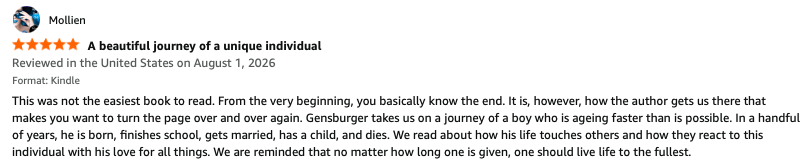
Order your copy of A BOY CALLED SWIFT today!
https://a.co/d/0csH89Tq AVAILABLE NOW in Paperback, eBook and Audiobook formats.
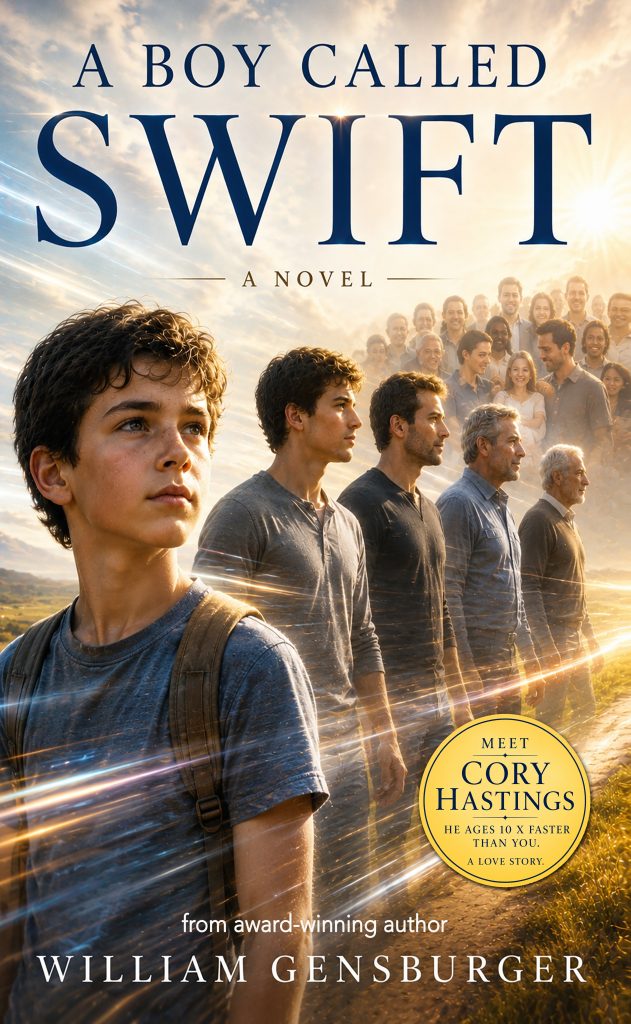
Born with a genetic defect that causes him to age physically and mentally 10 times faster than normal, Cory Hastings must navigate life and love in the short time he is alive. An emotionally stirring story that will grab you and not let go.
Cory Hastings was born on a stormy Tuesday night with dark eyes that track the room at three weeks old, speaks his first word at four weeks, walks at five, and is ready for university before his second birthday — because Cory ages at ten times the normal rate, living a full human lifetime in just nine and a half calendar years.
When the state tries to take him from his family, a community gathers outside his door and does not leave. When a young literature student named Elaine sits across from him in a library, and he tells her the truth about his life, she goes home and thinks about it for seven days before responding.
What follows is a life that burns hotter and truer than most people find in a lifetime, a philosophy built on four words Cory lives completely, and a question that the novel asks on every page and answers differently each time: what does it mean to pay full attention to a life, knowing it will not last forever? A Boy Called Swift is the most human story imaginable, told at extraordinary speed, and it will stay with you long after the last page.
“An excellent book … a book that will stir your
heart and mind and make you want to live
fully in the moment every second of your life.”
~ W. Martin
“I spent part of last weekend reading your
book on my computer. I loved it and think it
will become a classic…a book such as yours
that is nearly perfect as is.” ~Karyl Mehlman
“I cried throughout; it was so beautifully
written. And joyful.” ~Carolyn Krauser
EXCERPT:
He met Elaine on the fourth day. He had been in the university library, a high-ceilinged Victorian building that smelled of old paper and radiator heat and the particular institutional quiet of a place where thinking is the primary activity, working at one of the long oak tables near the tall windows, when someone sat down across from him with the purposeful energy of a person who has identified a chair and intends to use it and is not particularly interested in who is already at the table.
She had dark hair, cut to her shoulders, and she was carrying four books and a coffee that was technically not allowed in the library, and a bag over one shoulder that appeared to contain approximately everything she owned.
She dropped the bag, stacked the books, pulled out a battered notebook, uncapped a pen, and began writing without looking up. All of this took perhaps thirty seconds. Then she looked up. She looked at Cory. She looked back at her notebook. Then she looked up again.
“You’re him,” she said; not starstruck, she was not a person who did starstruck, but interested, the way she was interested in everything, with her whole face.
“I’m Cory,” he said.
“I know who you are. I’m Elaine. I’m doing my PhD in literature. I’m supposed to be writing about Milton right now.” She looked at his work spread across the table. “Is that topology?”
“Algebraic topology, yes.”
“Hm.” She uncapped her pen again. “I don’t know what that is, but it looks serious.”
“Milton is serious, too.”
She looked at him over the top of her notebook with dark eyes that were quick, assessing, and faintly amused. “Yes,” she said, “but Milton has been dead for three hundred and fifty years, and he can wait. Topology is presumably more urgent.”
Cory considered this. “Actually, topology is largely concerned with properties that are preserved through continuous deformation. Urgency is not a factor.”
Elaine stared at him for a moment, then laughed: the full laugh, loud enough that the student two tables over looked up with irritation, which she did not notice or did not care about, which Cory was already understanding was the same thing where she was concerned. “All right,” she said. “I like you. Don’t make it weird.” And that was that.
What followed, over the next three weeks, was a friendship that arrived fully formed and immediately comfortable, the way certain friendships do when two people have the good fortune to find each other before either of them has worked out the proper way to be cautious. Elaine moved through the world at a velocity that Cory found both familiar and entirely new, new because hers was emotional and social and comic rather than intellectual, though it was that too. She had opinions; many opinions, on many subjects, delivered with the cheerful force of someone who enjoys being disagreed with because that was also interesting. She could argue for a position she didn’t hold just to see where the argument went. She could change her mind completely in the middle of a conversation and announce the change without embarrassment. She laughed at things that surprised her and was surprised by things that other people found ordinary, and found ordinary things that other people found surprising. She was, in the most specific sense of the word, alive: fully, noisily, unapologetically alive.
Cory, who had been thinking about the nature of aliveness since he was old enough to understand his own situation, found this remarkable in a way he could not immediately articulate. He filed it away and continued to find it remarkable and said nothing about it. They fell into a daily habit without discussing it: library in the mornings, his table, her coffee that was not allowed in the library; lunch in the refectory, where she ate quickly and talked continuously, and he ate methodically and listened with his full attention, which she noticed and did not comment on, but which affected her in ways she would not admit for several weeks.
The literature seminar was her idea. Of course, it was her idea. She had been attending a graduate seminar on the Romantics, run by a professor named Whitmore who had strong opinions about who belonged in his seminar room and had made those opinions clear at the first session: graduate students in literature only, no auditors, no exceptions.
Elaine mentioned to Cory, on a Wednesday afternoon, that they were discussing Keats the following day, specifically the question of what Keats understood about beauty and mortality that other poets hadn’t. Cory was quiet for a moment, then said, “I have thoughts about that.”
Elaine looked at him with the faintly amused expression she wore when something was becoming interesting. “Do you?”
“Keats died at twenty-five. He wrote his best work in the last two years of his life. The compression of time produces a certain density of attention. I find that I have thoughts about that.”
Elaine looked at him for a long moment, then said, “Wear something that doesn’t make you look twelve. Meet me outside Whitmore’s building at two.”
She smuggled him in via the side door during the ten-minute break between seminars, seated him in the back row with her coat over the chair in front to partially obscure him, and returned to her own seat with the focused innocence of someone who is definitely not doing anything. It lasted twenty-five minutes before Professor Whitmore, whose peripheral vision was apparently exceptional, stopped mid-sentence and looked at the back row and said, “Miss Calloway, who is that?” There was a pause.
“A friend,” Elaine said.
“I can see that. What is your friend doing in my seminar?” Another pause.
Cory, in the back row, said pleasantly, “I was interested in the question of whether Keats’s awareness of his own mortality accelerated his artistic development or whether it was coincidental with it. I have a perspective on acceleration that might be relevant.”
The seminar room went very quiet. Professor Whitmore looked at the back row for a long moment; he was sixty-five years old and had been teaching the Romantics for thirty-five of them, and had, in that time, developed a reliable instinct for when something interesting was about to happen in his seminar room. “All right,” he said slowly. “Let’s hear it.”
What followed was forty-five minutes that three of the graduate students present would later describe as the best seminar they attended in their entire time at Caldwell. Cory spoke about acceleration and artistic production not theoretically but from the inside, with the authority of someone who is living the question rather than studying it, and the room listened with the particular quality of attention that arrives when something real has entered the space.
Professor Whitmore, at the end, looked at Cory over his reading glasses and said, “You may come back.”
In the corridor afterward, Elaine walked very fast for thirty seconds and then stopped and leaned against the wall and laughed until she had to hold onto Cory’s arm to stay upright.
“His face,” she said, when she could speak. “When you started talking. His face.”
Cory was smiling, the real smile, the one that seemed to reach his eyes. “You looked very innocent,” he said. “For about four seconds.”
“I am innocent,” she said, straightening up, pulling her coat on with dignity. “I simply brought a friend to a seminar. The fact that Whitmore doesn’t allow friends is a limitation of his, not mine.”
They were spoken to by the department administrator the following morning. The conversation concluded with an understanding that Cory would be welcome to attend the Romantics seminar as an unofficial auditor, which was precisely what Elaine had intended from the beginning and which she accepted with the gracious surprise of someone who had not been planning this all along.
Cory paid the administrator’s fine for the unauthorized library coffee out of his own pocket, which Elaine discovered two weeks later, and which she was still arguing about years later, which is a different story and a long time from now.
The pub was called The Aldren Arms, and it sat on the riverbank a ten-minute walk from the campus gate, low-ceilinged and warm, with booths along the back wall and a landlord who had been there longer than the current faculty and had opinions about all of them.
Elaine went there on Friday evenings as a matter of principle, which she explained to Cory on the third Friday as: “The week needs a door. This is the door.”
Cory went with her. It became, like the library table and the refectory and the Romantics seminar, simply part of the pattern of their days. On the Friday of their fourth week at Caldwell, a warm evening in May with the pub windows open to the river smell and the last light coming in sideways and gold, Elaine had two glasses of wine and became more herself than usual, which was saying something. She talked about her PhD, about Milton’s Satan and why she found him more interesting than God, about her parents Edgar and Helen and the house she had grown up in and the dog they had called Professor who had deserved the name, about the year she had spent in Florence after her undergraduate degree eating too much pasta and being comprehensively wrong about a boy named Marco, about the things she believed and the things she had stopped believing and the things she believed again now that she was older.
She talked the way she always talked: quickly, with her hands, changing direction mid-sentence when something more interesting occurred to her, except that the wine had taken the last of the self-editing out of it and what was left was purely Elaine, unfiltered, loud, and funny and startlingly honest. Cory listened. He had his own drink in front of him, mostly untouched, because he was concentrating.
“What about you?” she said eventually, refilling her glass with the focus of someone performing a precise operation. “You never talk about yourself. You ask questions, and you listen, and it’s very nice, but it’s also a bit strategic.”
Cory looked at her. “I’m not strategic,” he said. “I just like listening to you.”
She pointed at him with her wine glass. “That is exactly the kind of thing a strategic person says.”
He was quiet for a moment. The pub moved around them: voices, laughter, the landlord behind the bar, the river smell through the open windows. Then he said, “What do you want to know?”
“Everything,” she said, without hesitation. “I want to know everything. I always want to know everything. It’s a character flaw.”
He looked at her for a long moment. She looked back at him with her dark eyes, warm with wine and attention and the particular quality she had of making people feel that what they were about to say mattered. And Cory Hastings, who was two calendar years old and twenty developmental years old and had been carrying the truth of his situation since before he had words for it, told her everything.
He told it quietly and without drama, in the low warm light of The Aldren Arms with the river outside and the evening moving on around them. He told her about the condition, what it meant, and how it worked. He told her about the mathematics of his life: the calendar years and the developmental years and what the gap between them meant for the future. He told her about the nine remaining calendar years, now eight and a half or so. He told her what Dr. Voss had said, and what the numbers suggested, and what he expected the end to look like, in the general way that anyone could expect anything.
He told her that he knew, coming to Caldwell, that he had roughly six calendar months before he had outgrown what the university could give him. He told her that he had come anyway, because of the people, because of the experience, because five developmental years among people who loved what he loved was worth having even if the calendar said six months. He told her that he was telling her this now because she had asked for everything and he was not capable of giving her less than that, and she deserved to know what she was dealing with. When he finished, she was quiet for a long time, looking at the table, her wine glass untouched for the last ten minutes. Then she said,
“That’s a lot.”
“I know,” he said.
“I need to…” She stopped. She picked up her wine glass and set it down again without drinking. “I need to go home.”
“Okay,” he said. She gathered her coat and her bag, and she looked at him once more across the table, an unguarded look, nothing composed about it, just Elaine at twenty-four with something enormous sitting on her that she had not yet worked out how to carry, and then she went.
Cory sat in the booth for a while after she left. The landlord collected her glass. The pub moved on around him. He put his thumb on the bracelet and moved it across the beads, slowly, one by one. He did not regret telling her. He had never been able to regret telling the truth. But he felt the absence of her already, like a change in the air pressure of a room.
A BOY CALLED SWIFT is available now! Grab yours TODAY!
https://a.co/d/0csH89Tq